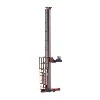

The most immediate value of warehouse automation equipment lies in enhancing operational efficiency. Technologies such as conveyors, automated sorting systems, handling robots, and vertical lifting equipment reduce the time spent on manual handling, sorting, and retrieval, enabling the rapid transport of goods along predefined routes. Particularly in high-volume warehouses, automation equipment operates continuously, thereby boosting overall inbound and outbound efficiency.
Automation equipment also maximizes warehouse space utilization. While traditional warehousing is constrained by the reach and height limitations of manual labor, automated high-density racking, stacker cranes, and vertical lifting systems fully exploit vertical space. This allows for increased storage capacity within the same footprint while ensuring orderly goods placement, which facilitates easier location and retrieval.
Warehouse automation equipment integrates with barcodes, sensors, and Warehouse Management Systems (WMS) to track the location, quantity, and inbound/outbound status of goods. Systems can schedule equipment to execute tasks based on order data and provide real-time feedback on operational outcomes. This minimizes errors associated with manual record-keeping, improves inventory accuracy, and allows staff to monitor warehouse operations effectively.
Furthermore, warehouse automation equipment reduces the physical strain on personnel and enhances operational safety. Mechanical equipment handles the heavy lifting-such as moving heavy loads, transporting goods over long distances, or accessing items stored at heights-thereby minimizing the need for direct manual intervention. Although automation equipment requires an initial investment, the long-term benefits include improved operational efficiency, reduced labor costs, and a solid foundation for the transition toward intelligent, modernized warehouse management.